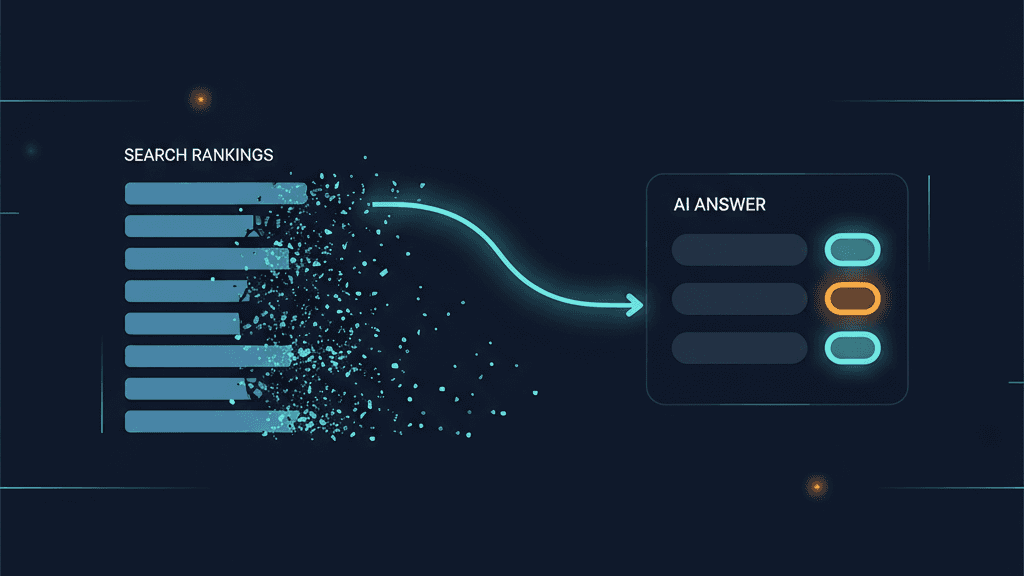
For twenty years, the B2B buyer's journey started the same way: someone had a problem, ran a Google search, and worked down a page of blue links. Rank near the top, and you earned a place on the consideration list. That pattern is now breaking. In G2's most recent B2B buyer survey, 51% of software buyers said they begin their research with an AI chatbot more often than with Google — up from 29% just eleven months earlier. The sources those assistants quote have little in common with the pages that rank in search: the overlap between top Google results and AI-cited sources has collapsed from roughly 70% to under 20%. And the old channel is shrinking, with Gartner projecting search volume will fall about 25% by 2026 as queries move to AI. The shortlist, long the most fought-over real estate in B2B marketing, is now drafted in part by software before a salesperson is ever involved. Most vendors haven't noticed.
The First Move Has Changed
For twenty years the buyer's journey started the same way. Someone had a problem, ran a Google search, and worked down a page of blue links. If you ranked near the top, you earned a place on the consideration list. That pattern is now changing. In G2's most recent B2B buyer survey, 51% of software buyers said they begin their research with an AI chatbot more often than with Google, up from 29% eleven months earlier. For a growing share of buyers, the chatbot has become the first stop.
The effect goes beyond habit. G2 found that 69% of buyers ended up choosing a different vendor than they first had in mind after working with an AI chatbot, and about one in three bought from a vendor they had never heard of before that conversation. The shortlist, long the most fought-over real estate in B2B marketing, is now drafted in part by software before any salesperson is involved.
Why This Breaks the Old Playbook
It is tempting to treat this as SEO with a new coat of paint, on the assumption that strong rankings will carry over into AI answers. They mostly do not. An analysis from 5W Public Relations found that the overlap between the pages ranking at the top of Google and the sources AI engines cite has fallen from around 70% to under 20%. The page that wins the search result often is not the page feeding the answer. You can sit at position one in Google and still be missing from the response your buyer reads.
This gap matters more because the old channel is shrinking at the same time. Gartner has projected that search engine volume will drop about 25% by 2026 as AI assistants take on questions that used to go into a search box. So there are fewer searches, and the results that remain no longer match what the AI cites. The familiar scoreboard of keywords, backlinks, and page-one rankings now tracks a game that fewer buyers still play.
"Ranking is no longer the prize. The prize is being cited, and described correctly, inside an answer your buyer trusts and you never get to see."
From Ranking to Being Cited
A discipline has grown up around this problem. Some call it Generative Engine Optimization (GEO), others Answer Engine Optimization (AEO). The acronyms matter less than the goal. When a buyer asks an assistant which vendors are best for a given job, you want your firm named in the reply, and you want what it says about you to be accurate.
What earns a citation is not the same as what earns a ranking, though the ingredients are familiar enough. Clear, well-structured content helps, because a model can pull a clean answer out of it. Authority helps more. AI engines favor sources that other credible sites already reference, which is why outside validation counts for so much. On that point, G2 found that citations from independent review sites are the strongest reason buyers give for trusting an AI's recommendation, ahead of a vendor's own website. Recency matters too. Pages that are kept current tend to get picked up, while stale ones get passed over.
None of this is new advice for a firm that already publishes solid, well-organized expertise and earns outside recognition for it. What has changed is who reads first. The first reader is now a machine, and it decides which firms make it in front of a person.
Why It Matters Now
There are two practical reasons to care, beyond keeping up appearances. The first is the quality of the traffic. Through 2025, several analyses found that visitors who arrive from AI engines convert at higher rates than visitors from ordinary organic search, sometimes several times higher in B2B. One widely cited dataset put ChatGPT referrals near 16% against under 2% for Google organic. The exact numbers move around and lean toward research-heavy categories, so treat them as a direction rather than a benchmark. The pattern itself holds. Someone who arrives already pre-sold by an AI recommendation tends to be further along and readier to talk.
The second reason is risk. The same engine that can recommend you can also get you wrong, or leave you out. G2 found that 64% of buyers run into inaccurate AI recommendations often or very often. If you are missing from the answer, you lose consideration. If you are there but described badly, you can lose the deal before anyone on your team hears about it. Neither problem shows up in a standard SEO report, yet both shape how buyers see you.
What This Means for Sales and Marketing Teams
Most of the response costs attention rather than budget. A few places to start.
Check the answer yourself. Run the questions your buyers actually ask through ChatGPT, Perplexity, and Gemini, and note where you show up, where competitors show up, and whether the description is right.
Write so you can be quoted. Put direct answers to real buyer questions near the top of the page, where a model can lift them without guessing.
Earn outside mentions. Get onto the review sites, roundups, and independent lists that both buyers and models treat as proof.
Keep it current. Update your most important pages and show the date. Stale material gets discounted.
Watch what the engines say. Track the accuracy of AI answers about your firm the way you already track reviews.
It is still early. The opening exists mostly because most competitors have not started looking yet.
The New Scoreboard
For two decades, being found meant ranking well. Today it often means being quoted well, named and named correctly, inside an answer the buyer trusts and the vendor never sees. The teams that win the next shortlist will not be the ones with the best Google rankings. They will be the ones the assistants are willing to cite.
Download the full insight for the complete picture on how the B2B shortlist is being redrawn, the shift from ranking to citation, and the practical playbook for sales and marketing teams, with supporting research.