
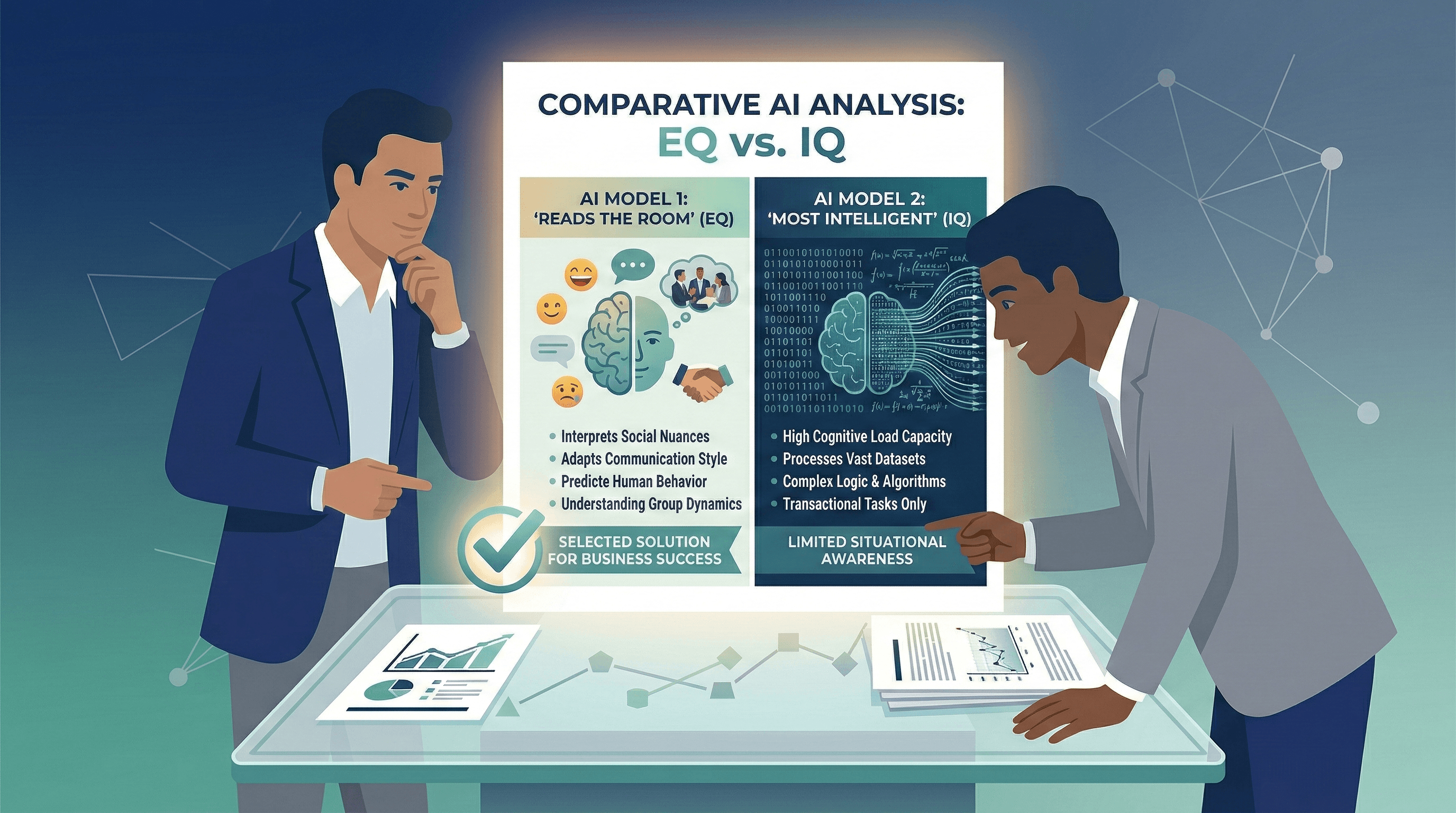
Across industries, leaders investing in AI are discovering that the metric they've been optimizing — raw model intelligence, as measured by academic benchmarks — is often less decisive than a capability they barely discuss in board presentations: how much information a model can see at once. The size of a model's context window has quietly become the binding constraint on enterprise AI's real-world usefulness. And the implications for technology strategy are profound.
The Billion-Dollar Blindfold
A Fortune 100 financial services company tested two large language models on a task that mattered: reviewing a portfolio of commercial loan agreements — 847 pages — to identify contradictory covenants across documents. The top-ranked reasoning model, limited to processing documents in chunks, took four hours and missed critical cross-document contradictions. The second model, which could hold all documents in a single context window, found every issue in minutes.
The head of AI strategy told his board something that would have sounded heretical a year earlier: they'd been optimizing for IQ when they should have been optimizing for field of vision.
The Intelligence Trap
The AI industry has spent three years in an arms race over intelligence. Every model release comes with leaderboard scores: accuracy on exams, pass rates on competitive programming, performance on standardized tests. Executives have been choosing AI systems the way universities choose students — by test scores.
The problem is that enterprise work doesn't look like a standardized test. Summarizing a 200-page regulatory filing, reconciling contract versions, tracing a bug through 40,000 lines of code — none of these require solving differential equations. All of them require the model to hold a large volume of information in working memory simultaneously. A model that scores 95% on reasoning benchmarks but can only process 8,000 tokens at a time is, for these tasks, functionally limited.
The model that sees the whole room will outperform the model that thinks harder about one corner of it.
The Context Intelligence Matrix
We propose a more useful evaluation framework — the Context Intelligence Matrix — that accounts for both dimensions of real-world AI performance: model reasoning capability and effective context utilization.
The matrix reveals four operating zones. Most enterprise AI spending today is concentrated in the "Smart but Blindfolded" quadrant: brilliant reasoners that are starved of data. They produce impressive analysis of whatever fragment lands in their window, but miss connections that span beyond it. The "Sweet Spot" — where enterprise AI creates disproportionate value — combines strong reasoning with the ability to effectively use large context windows.
Critically, a model's advertised context window is not its effective context window. Research shows performance degrades 14–85% as input length increases, even within the model's technical capacity.
When Context Wins: Real-World Cases
In a cross-border acquisition, a global firm needed to review 12 overlapping contracts for inconsistencies. Their RAG-based pipeline returned the most similar clauses — which were the ones that agreed with each other. The contradictions, buried in dissimilar language across documents, never surfaced. Switching to a long-context model that could hold all 12 contracts simultaneously surfaced seven cross-document issues, three material to the deal.
A cybersecurity company found similar results. Analysts had been pre-filtering investigation data before feeding it to AI — unconsciously embedding their own assumptions about what mattered. A model with a larger context window began surfacing threat patterns that analysts had filtered out as noise, including a lateral movement technique that had been present in logs for three weeks.
Five Moves for Monday Morning
Adopting a context-first strategy means rebalancing how you evaluate AI. First, audit your actual context requirements — measure the real-world input sizes your highest-value tasks demand. Second, benchmark on your tasks, not public leaderboards. Run candidate models against your actual workloads at your actual input sizes.
Third, test effective context, not advertised context. Run evaluations at increasing document lengths and find the cliff where accuracy drops. Fourth, architect for hybrid retrieval — use RAG for routine queries and reserve long-context processing for cross-document reasoning. Fifth, invest in context engineering before model upgrades. Structuring and curating the information fed to models delivers more improvement per dollar than buying a smarter model.
Seeing the Whole Room
The organizations that will extract the most value from AI in the next three years will not be those that chase the highest benchmark scores. They will be those that match their AI's field of vision to the actual scope of their problems — and engineer the context to ensure nothing critical is left outside the frame.
The question is no longer how smart your AI is. It's how much of the problem it can see.
Download the full white paper for detailed case studies, the Context Intelligence Matrix framework, and the Context Effectiveness Curve analysis with supporting research.