
AI adoption in finance surged from 37% to 58% between 2023 and 2024. Then it stalled. In 2025, adoption inched up a single percentage point — to 59% — even as worldwide AI spending surged 44% to $2.5 trillion and 87% of CFOs declared artificial intelligence critical to their function's future. That one-point stall tells a bigger story than any vendor keynote. The bottleneck is no longer awareness, budget, or executive will. It is operational readiness — the ability of finance organizations to absorb AI into how they actually work.
The Diagnosis: Technology-Rich, System-Poor
Only 11% of financial firms report measurable ROI from their AI initiatives, according to Gartner's maturity data. A PwC survey confirms it from another angle — just 12% of CEOs say AI has delivered both cost and revenue benefits, while 56% report no significant financial impact at all. Pilot purgatory is not an exaggeration. It describes the vast majority of finance AI programs running today.
The root cause is an inverted investment pattern: 90% of transformation budgets flow to technology — systems, tools, licenses — while just 10% goes to the people, process, and data work that determines whether that technology produces value or expensive noise. This inversion explains why 70% of digital transformations continue to fail, a rate that has persisted for over a decade despite exponential improvements in the underlying technology.
Three specific failures keep finance organizations trapped. First, automating broken processes — when an AI agent receives fragmented data from disconnected systems, it accelerates chaos rather than creating value. Second, the "fingers and toes" problem: deploying narrow point solutions that automate isolated tasks without connecting them end-to-end, leaving humans to stitch disconnected AI outputs together manually. Third, a governance vacuum where new risks like prompt manipulation, opaque reasoning, and model drift go uncontrolled.
The Audit-Ready Autonomy Stack
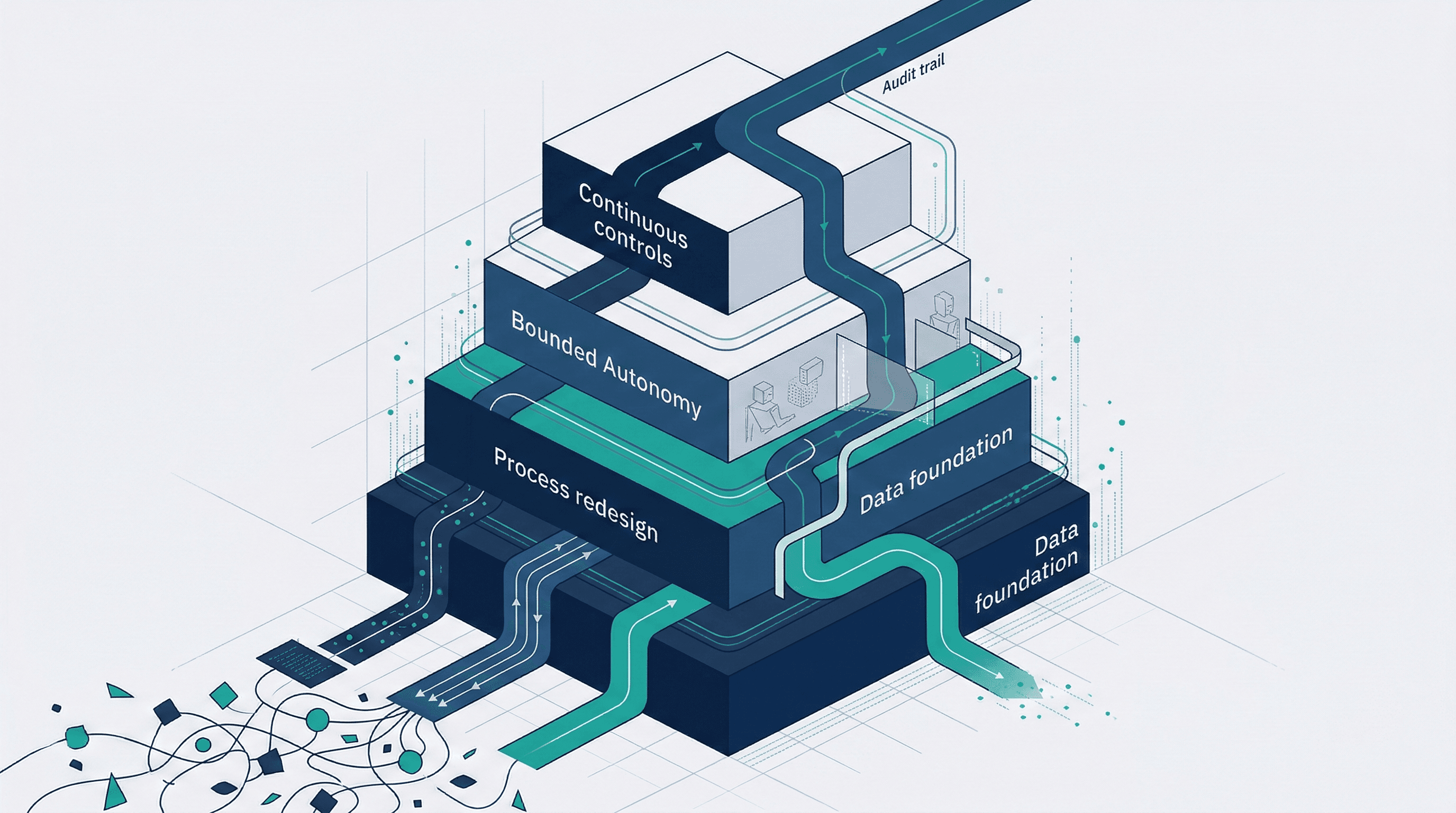
The finance organizations producing measurable AI returns share a common architecture — not a common vendor or use case, but a common sequence of investments. We call it the Audit-Ready Autonomy Stack: four layers that must be built in order, each enabling the one above it.
Layer 1 — Data & Semantic Integrity: Every scaling failure traces back here. Standard definitions, semantic layers, quality controls, and master data governance form the foundation because AI agents compound errors exponentially across multi-step workflows. In a 2026 KPMG survey, 82% of executives cited data quality as the top barrier to AI success.
Layer 2 — Process Redesign Before Automation: Before deploying any agent, map the end-to-end workflow it will inhabit. Define which decisions are deterministic, which require human judgment, and which require human ownership. This produces what most finance organizations lack: a clear role architecture for humans and machines working together.
Layer 3 — Bounded Autonomy with Escalation: Every agent operates within explicit policy guardrails — what data it can access, what actions it can take, what thresholds trigger human review, and what conditions activate a kill switch. The emerging "agent manager" model — one finance professional supervising 20 to 30 AI agents — is already appearing at early adopters.
Layer 4 — Continuous Controls & Evidence: Audit trails, anomaly detection, model-version monitoring, and compliance logging generate the evidence that transforms AI from a risk into an asset. Without this layer, you may gain speed but lose the ability to prove your numbers.
The organizations that will capture value from AI in finance aren't the ones with the most pilots. They're the ones that built the operating system first.
Where the Stack Breaks
Intellectual honesty requires naming the boundary conditions. The Stack assumes enough process complexity and regulatory exposure to justify the investment. For early-stage companies with fewer than 50 finance transactions per month, the overhead exceeds the value. Organizations undergoing active M&A integration will find Layer 1 unstable until the integration settles. And the model works best where finance leadership has genuine authority over process design — in companies where IT controls the technology agenda unilaterally, the cross-functional negotiation required for Layer 2 becomes a political obstacle.
None of these exceptions invalidate the model. They define its boundaries.
Three Patterns That Break the Stall
The Regulated-Industry Accelerator: Moody's adopted generative AI aggressively and early — surprising for a company whose value rests on analytical credibility. The approach worked because leadership built governance in lockstep with capability. It required slowing initial deployment by four months while compliance architecture caught up, generating internal friction and board-level debate. But the result was analysis regulators could verify, not just faster analysis.
The Mid-Market Equalizer: Mid-sized companies are finding that AI-powered FP&A tools let them move from static annual budgets to dynamic rolling forecasts. But democratization has a prerequisite mid-market firms underestimate: the data foundation must be clean enough for AI to produce trustworthy numbers, and mid-market firms typically carry more master-data debt than they realize.
The Workforce Inversion: A global CEO survey found 60% agree AI investments will lead them to maintain or increase hiring, while 57% of CFOs expect AI to reduce certain finance roles. Both numbers are correct — the workforce is bifurcating. Transactional roles decline; hybrid roles spanning finance, data, and controls expand. Organizations that train "agent managers" to orchestrate AI agents will emerge stronger. Those that treat AI purely as a headcount reduction lever will find themselves short of the judgment capacity they need.
What to Do This Quarter
First, inventory and classify every AI use case currently active in your finance function. Most organizations cannot produce this list. For every use case, document the workflow owner, data sources consumed, control evidence generated, and a decision date for whether to scale, redesign, or kill it.
Second, pick one end-to-end process and redesign it before adding new technology. Record-to-report is the best candidate for most organizations because it touches close, consolidation, reconciliation, and reporting. Map every step, every handoff, every exception path. Only then design where agents belong.
Third, build the minimum viable compliance backbone for 2026's regulatory wave. IFRS 18 takes effect for periods beginning January 2027, EU AI Act high-risk provisions activate in August 2026, and real-time tax reporting mandates are accelerating globally.
Fourth, assign an "agent manager" to your first production AI workflow — a named individual who owns performance, exceptions, and compliance for every agent in that workflow. If nobody owns the agents, nobody governs them.
The One-Point Question
That one percentage point — from 58% to 59% — represents the gap between organizations that bought AI and organizations that built the system conditions for AI to work. The technology is ready. It has been ready. What is not ready is the operating environment inside most finance functions.
The next twelve months will sort finance organizations into two groups. The first will keep adding pilots and keep explaining to boards why projected ROI hasn't materialized. The second will do something harder and less glamorous: fix the data nobody wants to touch, redesign processes that have been "good enough" for a decade, and build governance into the foundation rather than decorating it onto the surface.
The Audit-Ready Autonomy Stack is not a technology blueprint. It is a management discipline — one that demands finance leaders stop asking "What can AI do?" and start asking "What must be true inside our organization for AI to operate safely and accountably?"
Download the full white paper for the complete four-layer framework, detailed case studies, and the 90-day implementation sequence.