
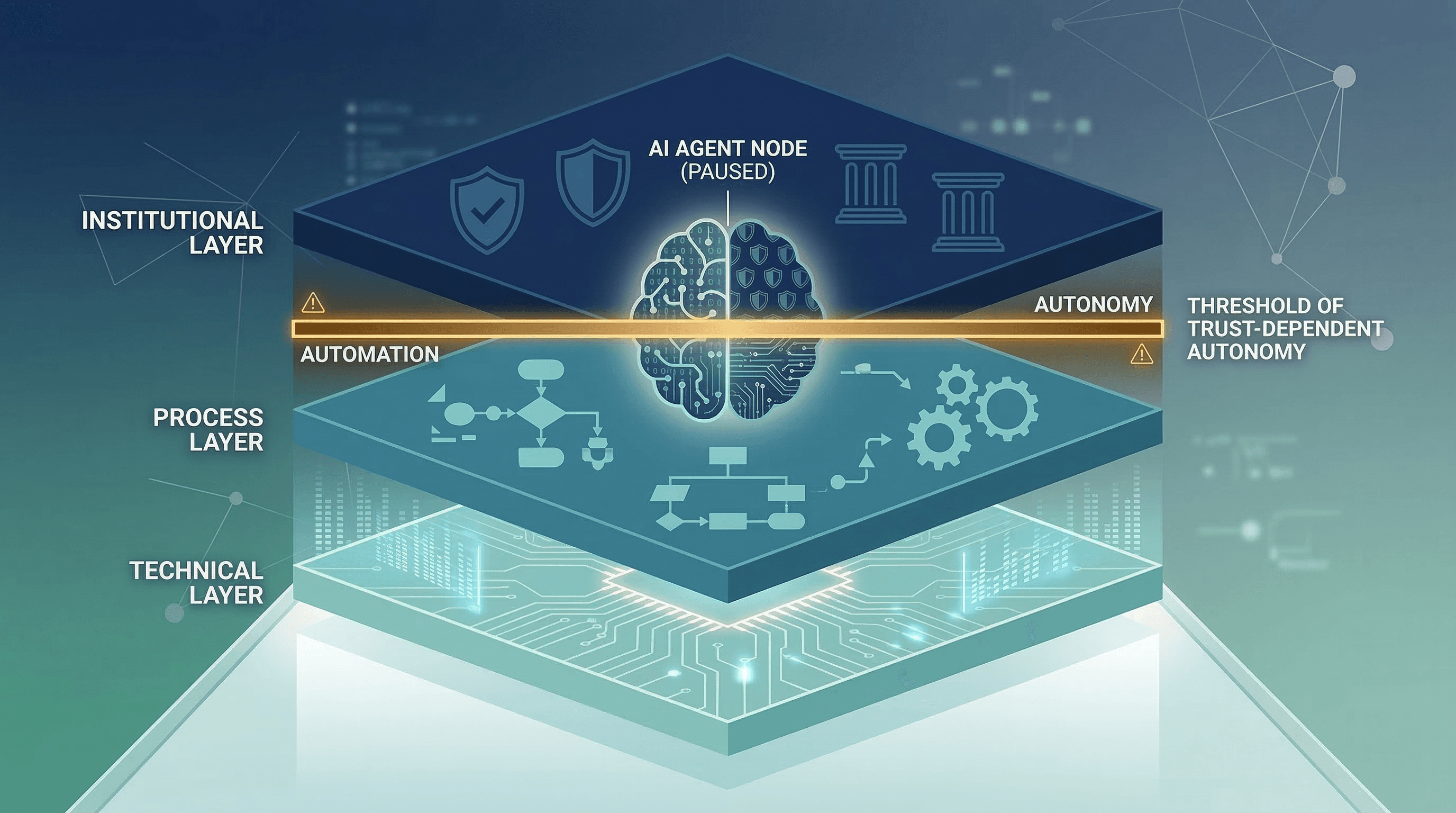
In late 2025, the corporate controller of a Fortune 500 industrial company watched a demonstration that should have been the highlight of her quarter. The company's newly deployed AI agent had processed 4,200 intercompany reconciliation entries overnight — work that previously consumed three full-time accountants for the better part of a week. The agent had identified 37 exceptions, correctly categorized 34 of them, and drafted resolution recommendations for each. By every efficiency metric, it was a triumph. Then she asked a question that revealed the chasm at the center of every finance AI deployment in 2026: "Who approved these entries?" She paused the deployment that afternoon — not because the technology had failed, but because the trust architecture around it did not exist.
The Paradox of the Perfect Candidate
Finance functions across every major enterprise survey report aggressive plans to adopt agentic AI. Over half of CFOs at companies with over $1 billion in revenue rank integrating AI agents as a top transformation priority for 2026. Two-thirds of senior Finance, Tax, and Accounting leaders have pilots underway or implementations in progress.
Yet beneath the headline adoption figures lies a sobering reality. Only 6% of finance leaders report high maturity levels — what would constitute enterprise-wide, scaled agentic operations. And Gartner predicts that over 40% of agentic AI projects across all functions will be canceled by 2027 due to costs, unclear value, or inadequate risk controls.
The gap between ambition and deployment is not a technology gap. The AI agents available today are technically capable of executing multi-step finance workflows: invoice matching, reconciliation, anomaly detection, variance analysis, even aspects of the financial close. The gap is a trust gap. And it manifests at three distinct levels that most organizations have not yet learned to distinguish.
The Trust Architecture: Three Layers That Must Align
The reason most finance organizations remain stuck in what we call pilot purgatory — cycling through proofs of concept without reaching production scale — is that they are trying to solve one trust problem when they actually face three. Each layer has different owners, different requirements, and different timelines.
Technical Trust asks whether the agent can do it correctly — model accuracy, hallucination rates, error handling, data quality integration. This is where most organizations focus, and progress is genuinely encouraging. But only 14% of CFOs completely trust AI technology to deliver accurate accounting data on its own, and 86% of finance teams have encountered at least one instance of hallucinated data.
Process Trust asks whether we can verify and audit what the agent did — audit trails, explainability, segregation of duties, rollback capability. This is the layer where deployments most commonly fail. Over half of organizations have no GenAI policies at work, and 64% reported receiving no GenAI training.
Institutional Trust asks whether regulators, auditors, and boards will accept the agent's actions as legitimate inputs to financial reporting. Only 2.7% of finance professionals fully trust AI agents for judgment calls. The vast majority trust agents only within tightly defined frameworks.
Speed without auditability isn't efficiency. It's exposure. The organizations that will lead in autonomous finance are not those deploying the most agents — they are those building the deepest trust.
The Autonomy Gap in Practice
The trust architecture framework explains a pattern visible across every major finance subdomain: a widening gap between where organizations are and where they expect to be. The domains with the strongest technical trust are moving fastest. The domains where institutional trust matters most are stuck.
Accounts payable leads because it sits in a trust sweet spot: high transaction volume, well-defined rules, mature data infrastructure, and limited regulatory sensitivity. AI-powered invoice matching engines have pushed touchless processing rates from 31% to 68% or higher. AP is where all three trust layers are closest to alignment.
FP&A and forecasting illustrate the opposite challenge. The technical capabilities are impressive, but FP&A outputs feed directly into board presentations, investor communications, and strategic decisions. While 88% of mid-market CFOs use at least one agentic AI tool, 97% insist that human oversight remains critical for ensuring data accuracy.
Tax and compliance face the most formidable trust barriers. Professional liability, regulatory scrutiny, and the precedent-driven nature of tax interpretation create an environment where even technically superior AI outputs face institutional resistance.
The Measurement Trap: Why ROI Alone Won't Close the Trust Deficit
A persistent misconception among finance leaders is that demonstrating ROI from pilot deployments will naturally build the trust needed to scale. It will not. Industry surveys report a median ROI of 10% from AI and GenAI in finance — respectable but not transformative. One-third of adopters report ROI below 5%, and only one-fifth report 20% or more.
The measurement problem runs deeper than ROI calculation. Agentic AI value measurement must separate three distinct categories: gross time reclaimed (hours saved), capacity reallocated (more volume handled with existing staff), and hard-dollar savings (headcount avoided or vendor leakage recovered). Most organizations conflate the three, and 82% of finance leaders expect no net headcount change from AI in 2026 — suggesting the primary value proposition is capacity reallocation, not cost elimination.
The organizations breaking through pilot purgatory have recognized that trust is not a byproduct of performance metrics. Trust is an infrastructure investment that must be made before performance at scale becomes possible — not after.
Five Moves to Build Trust Architecture Before Your Competitors Do
First, audit your trust layers before you audit your technology. Map each finance process targeted for agentic deployment against the three trust layers. The gaps revealed will explain why your pilots aren't scaling better than any technology audit ever could.
Second, build audit-grade logging from day one — not as a retrofit. Every agent action must produce a log entry that an external auditor can evaluate: what data was accessed, what logic was applied, what decision was made, and what human approval was obtained.
Third, establish a human-in-the-loop escalation framework tiered by risk, not by process. Design escalation thresholds based on materiality, counterparty sensitivity, regulatory exposure, and precedent — not process category.
Fourth, create a cross-functional AI governance council that reports to the CFO. Trust cannot be built within the finance function alone. It requires alignment between finance operations, internal audit, IT security, legal, and the board.
Fifth, negotiate AI governance into every vendor and outsourcing contract signed after today. Require contractual provisions for model drift monitoring, bias testing, retraining transparency, and the buyer's right to audit any AI-driven decision that touches financial reporting.
Where This Framework Breaks
The trust architecture model applies most cleanly to large enterprise finance functions with established control environments, external audit relationships, and regulatory obligations. It is less applicable to small and mid-market companies where the controller is the governance framework, and where the speed advantages of AI adoption may outweigh formal trust infrastructure investment.
The framework also assumes that the technology maturation curve will continue its current trajectory. If large language models develop substantially better reasoning capabilities and native auditability features within the next twelve to eighteen months, the technical trust layer may resolve itself faster than the institutional layer can adapt — creating technology that outpaces governance, rather than governance that constrains technology.
Finally, the trust challenge differs by geography. The EU AI Act creates binding obligations with specific timelines. The UK FCA takes a principles-based approach. The SEC focuses on disclosure and enforcement. A global finance function must navigate all three simultaneously.
Trust Is the Strategy
The controller who paused her reconciliation deployment did not abandon the technology. She spent eight weeks building what her company now calls its "AI Controls Framework" — a structured protocol mapping every agent action to an approval authority, an audit trail standard, and an escalation threshold. When she restarted the deployment, it scaled to full production within three months. The agent now processes reconciliation entries across 14 entities with a 96.4% accuracy rate. Monthly close cycle time dropped from eleven days to six. And for the first time, external auditors accepted agent-generated work products as audit evidence.
The broader finance profession stands at precisely this inflection point. The technology is ready. The ambition is unmistakable. The market for AI agents in financial services is projected to grow from $691 million to $6.7 billion by 2033. What remains to be built is not the machine. It is the trust that allows the machine to act.
Download the full white paper for the complete Trust Architecture framework, the Autonomy Gap analysis by finance subdomain, and the five-step implementation roadmap with supporting research.